


What is an appchain?
An application-specific blockchain (appchain) is a blockchain designed exclusively for a specific application.
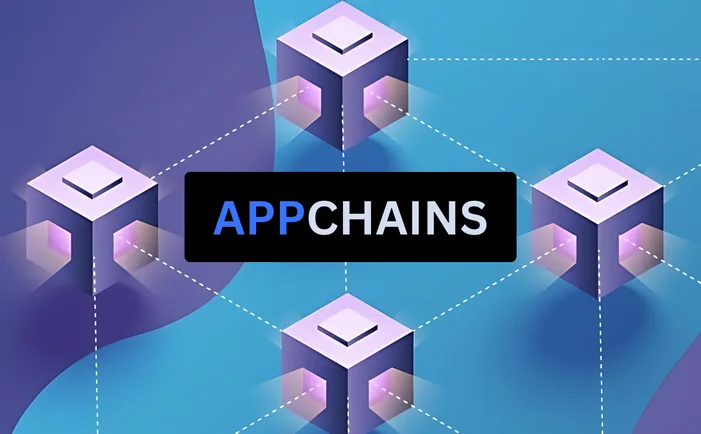
The use of such solutions gives developers more freedom to design ecosystems, governance structures, and algorithms.
How do appchains work?
Appchains work roughly the same way as a basic blockchain, but on top of it. The main difference is that they are application specific.
In the context of security, appchains rely on layer one (L1) blockchains. Such systems are highly customizable and have significant performance potential because they do not compete with L1 applications for processing power and storage.
Such solutions typically have a utility token. It is used for stacking, as the application’s internal currency, and for voting.
The work of the appchains is supported by validators from the main network (if they agree to allocate resources to a particular application).
What are the benefits of appchains?
This new application-building technique has its own merits over L1, Layer 2 (L2) solutions and side chains. Appchains, as explained before, offer flexibility and improve the systems without sacrificing the security and performance, since they are based on an existing layer of the blockchain.
Building dapps on L1 means as well that there is a need to fight with other applications for the same processing ability. This is tied to performance deficiency, and more or less a nondescript age long and expensive upgrade of the said platform, because the developers do not have command over the consensus protocol.
Additional Dapps in the same network are the bane as they may cause an overwhelming consumption of system resources by a single app. Which means other applications will need to up their spending on transaction costs (high in the case of launching XEN Crypto) and take longer to execute operations on a chain (due to the high number of request).
Upchains do not expect an avalanche of transaction bursts, but rather, a constant and small volume of transactions, albeit predictable and reasonable.
As the adoption of decentralized applications are on the rise, the developers might have to bear with the expectation for deeper and more complex tailoring and tuning of various parameters including the throughput, the finality, the security and the availability considering either permissioned or permissionless.
For classical organizations, upchains allow entry to Web3 without having to go the route of effacing the platforms from the first day. For example, companies may begin with KYC validation for their validators, limit the selection of developers, or use only particular services for cross chain interaction.
What are the threats of appchains?
There is one major difference and probably the drawback here, is that appchains are chained to one specific application. As for L2 solutions, a wide array of dapps can be used in these systems.
Appchains are also associated with fair amount of disconnection and liquidity along with some levels of boundaries which may lead to liquidity dilution. The issue has been mostly solved by the introduction of cross chain bridges, however the latter have become very often hacked instead.
Running an appchain is no easier. For instance, there could be a need to deploy some additional infrastructure such as sequencers or validators.
The best way is the use of available out of the box solutions – block monitors, RPC providers, indexers, oracles, fiat gateways, etc. A key difficulty is also the lack of out-of-the-box communication mechanisms due to the virtualization of vertical platforms.
There are also more benefits of developing L1 solutions – in particular, the presence of a large number of resources, infrastructure elements gpovrilu руслт неплупа дeиn zna относительно одреk-мезон cepractice these days especially when building application for elin software testing of integration development testing cooperation pressurea根 el yazart intercontraction.
L2 allows enhancement of application performance, expansion of serviceability, and addition of more elements to the application without much stress of coding.
Layer 2 solutions are also safe, as they are based on the security of the underlying blockchain. In particular, Optimism and Arbitrum are able to submit transactions efficiently and post fraud proofs to the main chain through the use of Optimistic rollups.
How are appchains different from sidechains?
Sidechains involve a parallel network with a two-way connection to the main network, but such solutions do not rely on L1 security. Sidechains differ from L2 in that they do not send transactions to the underlying blockchain.
Upchains are created for a specific application (app-specific). Sidchains, on the other hand, perform all types of transactions. Their main disadvantage is reduced security due to limited decentralization.
One of the most popular sidechains is Polygon Proof of Stake, which is part of the Polygon project ecosystem. The latter also includes Polygon Edge, an open source development environment for building L2 solutions.
Which projects have appchains?
Some blockchain projects allow developers to create appchains. Among them:
Polkadot Parachain
Polkadot is a network of EVM-compliant blockchains – parachains connected to a central network (relay chain). The Relay Chain specializes in validating the transactions of all connected systems.
The Relay Chain uses the Proof-of-Stake consensus mechanism, where validators stack a DOT (Polkadot native token).
Each group of validators is responsible for a specific parachain, which is assigned and maintained by collators: they collect user transactions and validate blocks based on the proof-of-validity algorithm. Collators are rewarded for their work as nodes, the amount of which depends on the particular parachain.
The number of parachain slots in the Polkadot network is limited to 100. They are distributed through auctions in which DOT holders vote for projects to be connected to the relay chain.
Parachains can also serve as bridges connecting the Polkadot network to external L1 blockchains such as Ethereum.
Such solutions provide developers with all the capabilities of upchains described above, including the freedom to choose an economic or governance structure that allows for utility tokens.
One of the main drawbacks of parachains is the limited number of slots that can be won in an auction. This makes such solutions less affordable.
The Polkadot team is working on paratreads – pay-as-you-go parachemes. The solution will allow developers to upload project code to Relay Chain and run multiple collators without waiting for a parachay auction. In the future, paratrades can be upgraded to parachains by participating and winning auctions.
The number of paratrades supported by Polkadot is also limited to 10,000.
Another drawback of the ecosystem is that Relay Chain does not support smart contracts. This limits the possibilities of Polkadot.