


Cardano Founders and Development Team
CCardano’s creation is the result of a synergy between brilliant minds in cryptography, engineering, and blockchain technology:
- Charles Hoskinson:
- Background: A mathematician and crypto-enthusiast, Hoskinson was involved in the early days of Ethereum.
- Vision: Frustrated with what he saw as limitations in Ethereum, Hoskinson envisioned a more scalable and sustainable blockchain platform.
- Role: As the CEO of IOHK, he’s the public face of Cardano, often explaining complex concepts in accessible ways through social media and interviews.
- Jeremy Wood:
- Background: An experienced technology executive with a focus on startup operations.
- Contribution: Wood’s business acumen complements Hoskinson’s technical expertise, helping to shape Cardano’s strategic direction.
The three key organizations behind Cardano each play crucial roles:
Global reach: Has offices in Singapore, India, Indonesia, and the United States.
IOHK (Input Output Hong Kong):
- Primary role: Technical development of the Cardano platform.
- Approach: Employs a team of engineers and researchers, many with academic backgrounds.
- Notable: Emphasizes peer-reviewed research and formal methods in development.
The Cardano Foundation:
- Primary role: Standardization, protection of the protocol, and promotion of Cardano.
- Activities: Engages in advocacy, forms strategic partnerships, and shapes legislation and commercial standards.
- Governance: Acts as an objective, independent body overseeing the development of the Cardano ecosystem.
Emurgo:
- Primary role: Drives the commercial adoption of the Cardano blockchain.
- Activities: Invests in startups, provides development support, and creates Cardano-based solutions for businesses.
Cardano (ADA) history
What is Cardano? It’s a cryptocurrency and a blockchain platform designed in 2015 led by one of Ethereum’s co-founders, Charles Hoskinson. As for the timeline of Cardiff development, foundation was laid in 2015, and the official network went live in 2017.
Cardano History and Development
Cardano’s development journey is marked by careful planning and methodical execution:
- 2015-2016: Conceptualization and Research
- Extensive research into existing blockchain technologies and their limitations.
- Development of the Ouroboros consensus protocol begins.
- 2017: Token Sale and Byron Era
- ADA token sale raises $62 million, demonstrating strong initial interest.
- Launch of the Byron era introduces the foundational architecture of the Cardano network.
- Focus on core functionality: ADA transfers and wallet operations.
- 2018-2019: Development and Testing
- Intensive period of development and refinement.
- Introduction of the Daedalus wallet and Yoroi light wallet.
- Testnet deployments and community engagement increase.
- 2020: Shelley Era and Decentralization
- Shelley mainnet launch marks a significant milestone towards decentralization.
- Introduction of stake pools and delegation mechanisms.
- Transition from federated block production to community-led block production.
- 2021: Smart Contracts and DApp Ecosystem
- Mary hard fork enables multi-asset support, allowing creation of custom tokens.
- Alonzo upgrade introduces smart contract capabilities, opening doors for DApp development.
- Launch of initial DEXs and DeFi protocols on Cardano.
- 2022-2023: Scaling and Ecosystem Growth
- Vasil hard fork enhances network capacity and smart contract efficiency.
- Significant growth in the number of native assets and smart contracts on the network.
- Continued work on Hydra and other scaling solutions.
Cardano Ecosystem
Cardano’s ecosystem is designed as a comprehensive blockchain solution:
- Blockchain Platform:
- Ouroboros Consensus: A provably secure Proof-of-Stake protocol.
- Energy Efficiency: Consumes a fraction of the energy used by Proof-of-Work systems.
- Scalability: Designed to handle high transaction volumes without compromising security.
- Smart Contracts:
- Plutus Platform: A purpose-built smart contract development and execution platform.
- Formal Verification: Enables mathematically proving the correctness of smart contracts.
- Marlowe: A domain-specific language for financial smart contracts.
- Native Tokens:
- Multi-Asset Support: Allows creation of custom tokens without smart contracts.
- Advantages: Lower fees, faster transactions, and enhanced security compared to ERC-20 tokens.
- Decentralized Finance (DeFi):
- Growing Ecosystem: Includes DEXs like SundaeSwap and MinSwap.
- Lending Platforms: Projects like Meld and Aada Finance.
- Yield Farming: Various protocols offering yield optimization strategies.
- NFT Support:
- Thriving NFT Scene: Multiple marketplaces like CNFT.IO and jpg.store.
- Unique Features: Native asset standard allows for more efficient NFT minting and transfer.
- Governance:
- Project Catalyst: A community-driven project funding mechanism.
- Voltaire Era: Plans for on-chain governance allowing stake-based voting on network upgrades and treasury spending.
- Academic Research:
- Peer-Reviewed Approach: Over 100 academic papers published.
- Collaborations: Partnerships with universities and research institutions worldwide.
In 2021, Cardano (ADA) has seen significant growth and adoption. The price of ADA increased significantly throughout the year, reaching new all-time highs, and it became one of the top 10 cryptocurrencies by market capitalization.
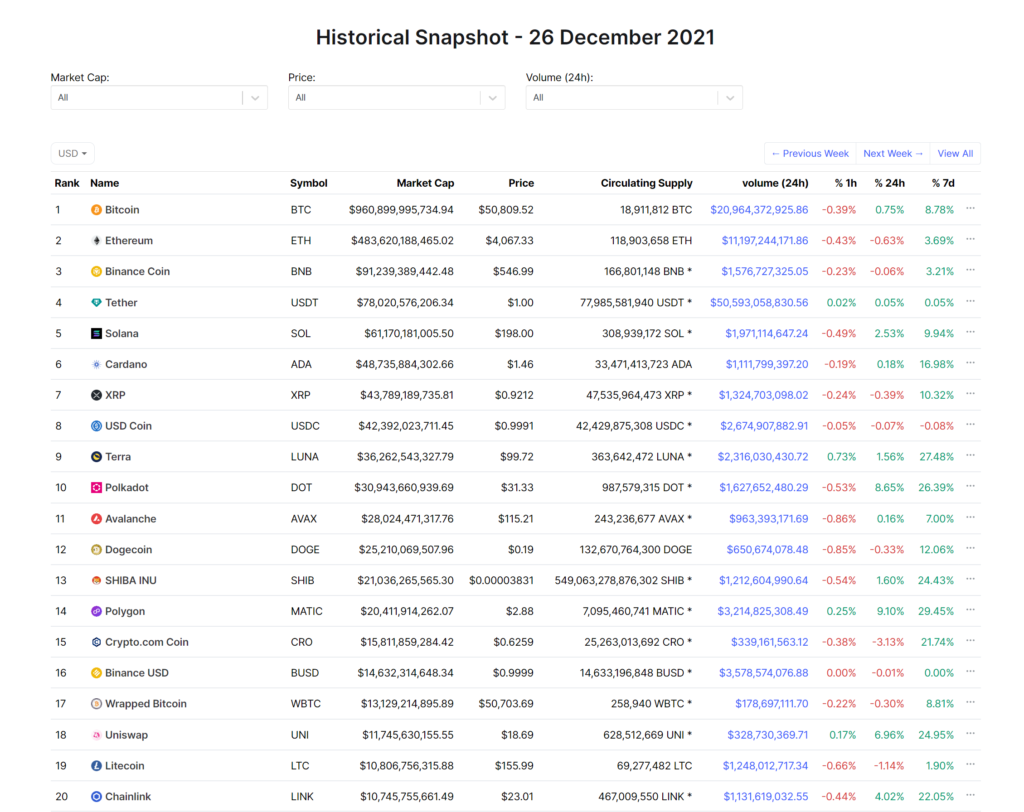
One of the main reasons for this growth is the increasing interest and adoption of Cardano by various sectors, such as decentralized finance (DeFi) and non-fungible tokens (NFTs). Cardano’s unique proof-of-stake consensus mechanism and its scalability potential make it a suitable choice for these use cases.
In addition, Cardano has been working on several updates and upgrades to the platform, such as the launch of the Alonzo hard fork, which enables the execution of smart contracts on the Cardano network, and the launch of the Plutus programming language, which is designed to make it easier for developers to build decentralized applications on the Cardano network.
Another factor that has contributed to the growth of Cardano is the increasing institutional interest in the cryptocurrency, with several institutions investing in Cardano and also using its technology.
Overall, 2021 has been a successful year for Cardano, with significant growth in price, adoption, and development. The future of Cardano looks promising as the platform continues to evolve and attract more attention and adoption. However, as with any cryptocurrency, it’s important to do your own research and consider all factors before investing.
Cardano (ADA) Token and Project Tokenomics
Cardano (ADA) is a cryptocurrency and the native token of the Cardano blockchain, an open-source decentralized platform for building and running smart contracts and decentralized applications. The project was founded in 2015 by Input Output Hong Kong (IOHK), and aims to provide more advanced capabilities than existing blockchain technologies.
The tokenomics of the Cardano project includes a fixed total supply of 45 billion ADA tokens, with an annual inflation rate of approximately 1%. The majority of the tokens will be distributed through a reward system for staking and validating transactions on the network. Staking involves holding ADA tokens in a wallet and participating in the consensus process that helps secure the network and validate transactions. The rewards for staking incentivize token holders to participate in the network and contribute to its security.
In addition to staking, the Cardano project has also implemented a decentralized governance model that allows token holders to vote on proposals for the future development and direction of the network. This allows the Cardano community to have a direct say in the development of the project and ensures its alignment with the interests of its users.
Overall, the tokenomics of the Cardano project aim to balance decentralization, security and scalability while incentivizing participation and alignment with the project’s vision and goals.
Principles
Cardano (ADA) is a decentralized blockchain platform that operates on a number of core principles:
- Scientific Philosophy: Cardano is based on a scientific philosophy, which means that it is built on a foundation of peer-reviewed research and academic collaboration. This ensures that the platform is built on a solid foundation of proven technologies and best practices.
- Sustainability: Cardano is built to be a sustainable platform, which means that it is designed to be energy-efficient and to minimize its environmental impact.
- Security: Cardano uses a combination of cryptographic techniques to ensure the security of the network and the data that is stored on it.
- Decentralization: Cardano is designed to be a fully decentralized network, which means that it is not controlled by any central authority or organization. This ensures that the network is secure and resistant to censorship and tampering.
- Interoperability: Cardano is designed to be compatible with multiple blockchain platforms, which allows it to be used by a wide variety of decentralized applications.
- Transparency: Cardano provides transparency and verifiability of the data that is stored on the network, which allows users to trust the data they receive.
- Incentivization: The network is incentivized by the token holders who earn rewards for participating in the network by staking their ADA tokens.
- Governance: Cardano is designed to be a community-driven platform, with a governance model that allows stakeholders to vote on protocol upgrades and other important decisions.
Future Plans and Roadmap
Cardano’s future development is guided by a comprehensive roadmap:
- Basho Era (Scaling):
- Focus: Optimizing Cardano for higher transaction volumes.
- Key Features:
- Sidechains: Allowing for customized blockchain implementations that connect to the main Cardano chain.
- Hydra: A layer-2 scaling solution aimed at processing millions of transactions per second.
- Interoperability: Enhanced cross-chain communication protocols.
- Voltaire Era (Governance):
- Focus: Establishing a self-sustaining system.
- Key Features:
- On-chain Voting: Allowing ADA holders to participate in decision-making.
- Treasury System: A portion of all transaction fees to fund future development.
- Complete Decentralization: Transition to a fully community-driven network.
- Beyond the Roadmap:
- Continuous Improvement: Ongoing research and development to stay at the forefront of blockchain technology.
- Real-World Integration: Expanding partnerships and use cases, particularly in developing economies.
- Sustainability Initiatives: Further reducing environmental impact and promoting sustainable blockchain practices.
The future outlook for Cardano is generally positive, as the demand for decentralized blockchain technology and smart contract platforms is likely to continue to grow. Cardano has a well-designed platform that addresses several key challenges facing the cryptocurrency and blockchain space, such as scalability, security, and interoperability.
In addition, Cardano has a growing ecosystem of developers, businesses, and users, which bodes well for its future prospects. The project also has a number of partnerships and collaborations with leading companies and organizations in the crypto and blockchain space, which further solidifies its position in the market.
However, as with all cryptocurrency and blockchain projects, the future of Cardano will depend on a number of factors, including technological advancements, regulatory developments, and overall market conditions. The project will also face competition from other blockchain platforms, and will need to continue to innovate and evolve to maintain its position in the market.
It is important for anyone considering investing in Cardano to carefully research the project and consider their own risk tolerance before making a decision. Cryptocurrency investments can be highly volatile and involve significant risks, so it is important to do your research and make informed decisions.
WARNING!

The contents of this article are not to be construed as legal, business, investment, or tax advice.
This article is intended for use and should be used for informational purposes only.


4 thoughts on “Cardano (ADA)”